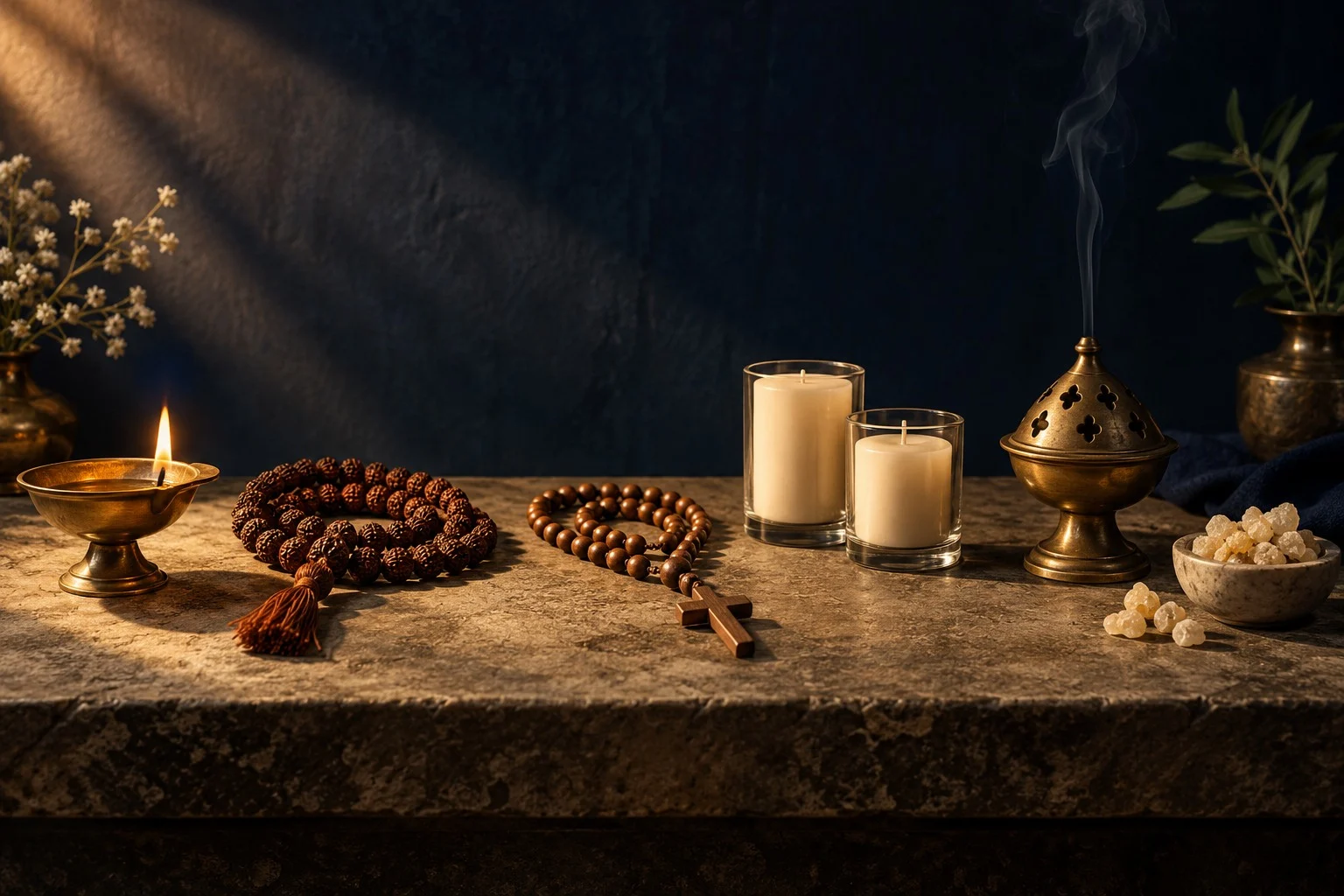
Nagi Harmony is the part of our catalogue that does not belong to one faith. It exists because the trade never did: the same Dhofar frankincense goes into a church censer and an Arabian mabkhara, the same Moradabad brass is spun into a temple lamp and a votive stand, and the workshops in Firozabad that press glass rosary beads press bangle glass on the next furnace along.
What follows is organised by tradition, because that is how people shop for it. The products underneath are organised by what they are made of, because that is how they are made and sourced. Both routes reach the same shelf.
The brief across all of it is the one the rest of the house works to: elevate daily ritual, bridge ancient sacred heritage and modern minimalist design, and make nothing generic. A diya, a rosary and a tasbih are different objects for different practices, and each one is judged the same way — on the material, the making, and whether it stands up to daily use.
The five lines
- NAGI Vedic — puja brass, dhoop and agarbatti, rudraksha and tulsi malas, camphor, wicks and lamps.
- NAGI ZamZam — attars, oud and bakhoor, janamaz, tasbih and misbaha. The line this house was built on.
- NAGI Grace — frankincense and myrrh, olive wood and glass rosaries, votive and sanctuary candles.
- NAGI Dharma — bodhi seed and sandalwood malas, brass vessels for offering lamps, sandalwood and agarwood incense.
- NAGI Heritage — Shabbat and Hanukkah candles, farm-grown white sage, permitted palo santo, soy ceremonial candles. Sikh and Jain goods join this line when we can source them properly.
By material
- Incense, Resins & Smudge
- Prayer Beads & Malas
- Ritual Candles & Lamps
- Puja & Temple Brass
- Travel Altar Kits
How we handle this
We sell objects, not outcomes. Every page here describes what a thing is made of, where it was made and how it is used in practice. None of them tells you what it will do for you, and none of them ranks one tradition against another.
Where a material is contested we say so on the product page rather than leaving it out: white sage is farm-grown and not wild-picked, palo santo is gathered from fallen wood under Peruvian permit, agarwood carries CITES Appendix II paperwork, and conch is bought only through licensed fishery channels. If the record is not there, we do not list the product.
Nothing we ship has been consecrated, blessed or energised at our end. That belongs to the person who buys it and to whoever they take it to.